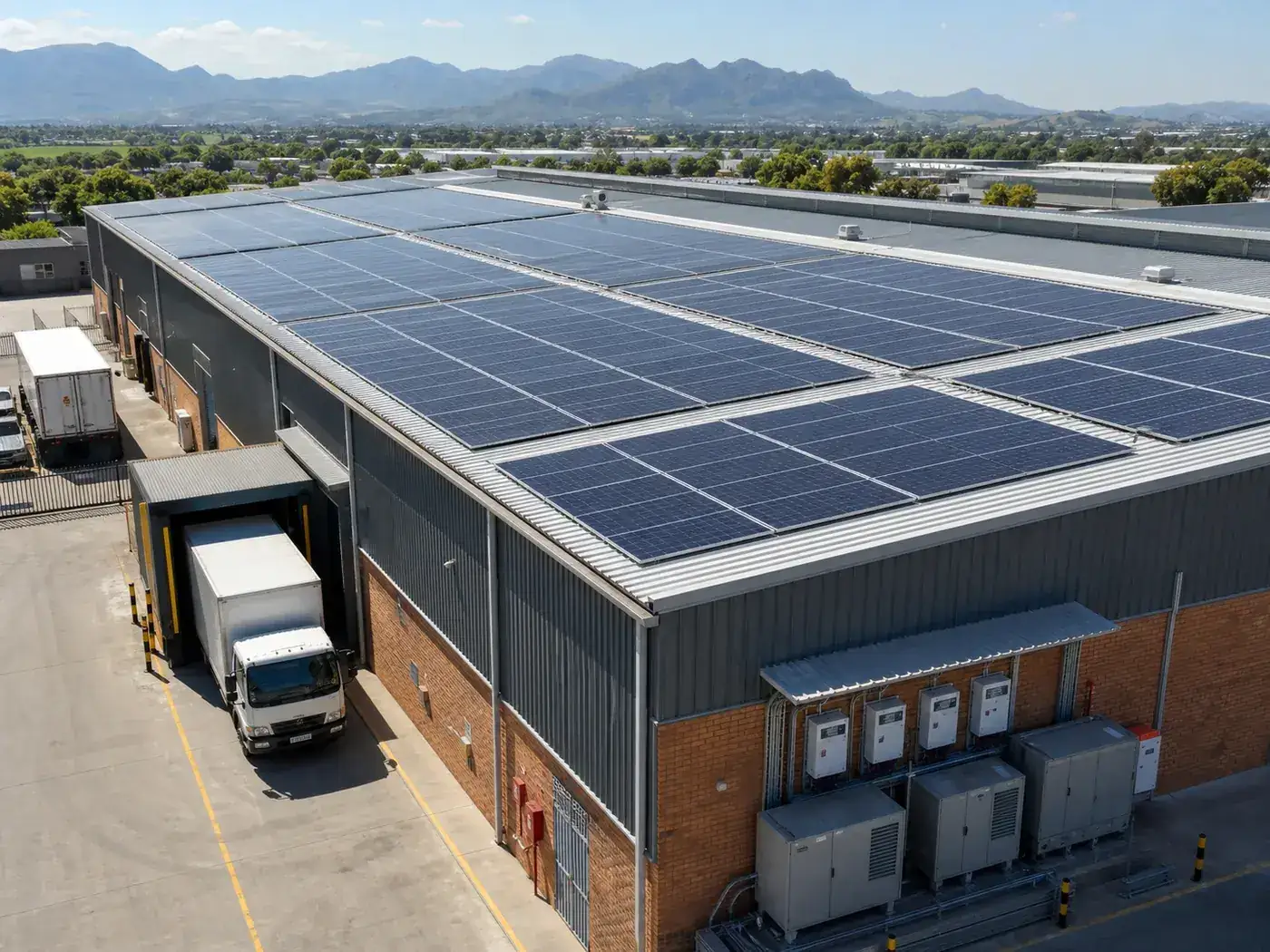
Commercial solar depends on operating hours, load profile, roof or ground space and the cost of interruption. Start with the business solutions overview and build the enquiry around your numbers.
Section 12B can allow a South African taxpayer to deduct the cost of qualifying solar-generation assets used for trade from taxable income. For photovoltaic systems that generate no more than 1 MW, the qualifying cost may be deductible in full in the year the assets are first brought into use.
That is a tax deduction, not a cash rebate and not an automatic discount on the installation invoice. Ownership, first use, the purpose of the asset and the way a transaction is financed all affect the result. This guide explains the current Section 12B rules, the temporary Section 12BA incentive that has already ended for new installations, and the questions to take to your tax practitioner before signing a solar contract.
Key takeaways
Section 12B remains relevant in 2026. Qualifying solar PV assets generating 1 MW or less can be deducted at 100% of qualifying cost in the year they are first brought into use.
Larger qualifying renewable-energy assets generally follow a 50:30:20 deduction over three years.
The temporary 125% Section 12BA incentive applied only to qualifying new and unused assets first brought into use from 1 March 2023 to 28 February 2025.
A deduction reduces taxable income. The cash tax benefit depends on the taxpayer's tax position and cannot be assumed from the system price alone.
Section 12B is technical. Confirm the asset, ownership, finance structure, first-use date and supporting documents with a registered tax practitioner.
What Section 12B allows
Section 12B of the Income Tax Act provides an accelerated allowance for qualifying assets used to generate electricity from specified renewable sources, including solar PV. SARS's official renewable-energy allowance guide sets out two deduction rates relevant to solar businesses and investors:
Qualifying asset
Section 12B deduction rate
Solar PV generating 1 MW or less
100% of qualifying cost in the year first brought into use
Solar PV above 1 MW and other qualifying renewable assets
50% in year one, 30% in year two, 20% in year three
The 1 MW test applies to the generating capacity of each photovoltaic solar system, according to the SARS guide. It is not a blanket promise that every item on a solar invoice qualifies. The facts of the installation and the wording of the Act determine the allowance.
Deduction versus tax saving
If a qualifying system costs R1 million, a 100% Section 12B allowance may create a R1 million deduction from taxable income. It does not create a R1 million cash refund. The tax effect depends on the applicable tax rate, taxable income, assessed losses, ownership structure and other limitations.
Use this basic framework when reviewing a proposal:
Establish the qualifying tax cost, not merely the invoice total.
Confirm the allowed deduction rate and the year in which the asset is first brought into use.
Apply the deduction within the taxpayer's actual tax calculation.
Keep the tax effect separate from electricity savings and financing cash flow.
Your accountant should model the result. SolarGuide's solar payback guide can help with the operating-savings side, but it is not a tax calculator.
Section 12B and Section 12BA are not the same
Many solar marketing pages still refer to a 125% renewable-energy incentive as though it were available for new 2026 installations. That temporary incentive was Section 12BA, not the ordinary Section 12B allowance.
Section 12BA allowed a 125% deduction for qualifying new and unused renewable-energy assets first brought into use from 1 March 2023 to 28 February 2025. An asset first brought into use after that window cannot qualify for the temporary 12BA allowance under the dates in the current SARS guide.
Section 12B did not disappear when Section 12BA ended. For a qualifying solar PV system of 1 MW or less, Section 12B's 100% first-year allowance can still be relevant. The distinction is important:
Provision
Rate
First-use window
Section 12B, solar PV up to 1 MW
100%
Ongoing, subject to the current law and all qualifying conditions
Section 12B, other qualifying cases
50:30:20
Ongoing, subject to the current law and all qualifying conditions
Section 12BA temporary incentive
125%
1 March 2023 to 28 February 2025 only
There was also a separate homeowner solar-panel credit under Section 6C. SARS states that it applied only to the 2024 year of assessment and was limited to qualifying panel costs. It is not a current general residential solar rebate. See the SARS solar credit FAQ for the historical rules.
Not sure which system you need?
Get a free, no-obligation quote sized to your home, usage and budget. It only takes a minute.
The SARS guide is detailed, but these are the issues a business should resolve before relying on the deduction.
The taxpayer must use the asset for trade
The renewable-energy asset must be used for the taxpayer's trade. A private homeowner installing solar only for personal consumption does not qualify simply because the same equipment would qualify in a business setting.
A property company, farm, manufacturer, retailer or other trading taxpayer may have a qualifying use, but the legal and tax facts still need to be checked. A home office or rented portion of a residence does not automatically turn an entire household installation into a business asset.
Ownership and financing matter
Section 12B generally concerns an asset owned by the taxpayer or acquired as purchaser under a qualifying instalment credit agreement. A rental, subscription, power-purchase agreement or lease can place ownership and the allowance with another party.
Do not assume that making the monthly payment gives your business the deduction. Ask the provider who owns the equipment during the contract, when ownership transfers, and which party intends to claim the allowance. Compare the answer with the contract and have your tax practitioner confirm it.
The allowance starts when the asset is first brought into use for the qualifying purpose, not necessarily when you pay a deposit or sign a quote. Commissioning records, invoices, contracts and handover documents should support that date.
This is particularly important when an installation crosses the taxpayer's year end. It was also decisive for the now-expired Section 12BA window.
Which solar costs can qualify?
Section 12B applies to qualifying machinery, plant, implements, utensils or articles used to generate electricity. SARS notes that direct acquisition and installation costs, and certain foundations or supporting structures designed for the asset, may form part of the deductible cost.
Treatment is fact specific. A sensible tax file should separate and describe:
PV modules and generation equipment;
inverters and equipment integrated into the generating system;
direct installation and commissioning costs;
qualifying supporting structures or foundations;
batteries and control equipment;
unrelated building work, maintenance, finance charges and service fees.
Do batteries qualify under Section 12B?
SARS says storage must form part of a system that generates electricity. A battery used only to draw and store grid electricity does not qualify on that basis. Whether a battery, inverter and related control equipment form part of a qualifying solar-generation plant depends on the system and the evidence.
Avoid a quote that labels the entire invoice "Section 12B eligible" without explaining the components. Ask the installer for an itemised asset schedule and let the tax practitioner decide the treatment.
A practical business review before you buy
Tax should strengthen a sound energy investment, not rescue a weak one. Review the project in four separate layers:
Operational need: Which loads must run during outages, and what does downtime currently cost?
Energy economics: How much grid electricity will the system displace under the business's actual tariff and operating hours?
Funding: Who owns the system, what are the payment obligations, and what happens at the end of the agreement?
Tax: Which assets qualify, which taxpayer can claim, and when are they first brought into use?
SolarGuide can introduce you to Alumo for a site assessment and commercial proposal. Ask for an itemised equipment and installation schedule that your accountant can review. Get a free Alumo quote →
Free planning tool
Solar finance and payback calculator
Compare cash payback with a financed system, using your own bill, tariff and assumptions.
R 2 500
R 110 000
70%
Payment route
Cash payback
5.2 years
20-year net saving
R 851 001
Year-one saving
R 1 750/mo
Estimated array
4.4 kW
About 8 × 550 W panels
Roughly 23.3 m² of usable roof
Indicative scenario only. It excludes finance fees, tax effects, maintenance, export credits and site-specific generation. The assumptions are visible below so the result can be challenged instead of treated as a quote.
Your tax practitioner may need more than the supplier invoice. Keep:
the signed purchase or finance agreement;
proof of ownership or the instalment credit terms;
itemised invoices and payment records;
equipment specifications and system capacity;
commissioning and first-use records;
the electrical CoC and SSEG documents where applicable;
calculations showing which costs were included or excluded; and
records of later improvements, disposal or insurance proceeds.
Disposal can trigger tax recoupment. Include the accountant before selling, transferring or restructuring an asset on which an allowance was claimed.
Sources and update note
This article was reviewed on 19 September 2026 against SARS's Guide on the Allowances and Deductions Relating to Assets Used in the Generation of Electricity. It is general information, not tax advice. Tax law, ownership structures and individual circumstances can change the outcome.
Frequently asked questions
Is Section 12B still available for solar in 2026?
Yes. Under the current SARS guide, qualifying solar PV assets generating 1 MW or less can receive a 100% deduction in the year they are first brought into use. The separate 125% Section 12BA window has ended for new assets.
Did the 125% solar tax incentive end?
Yes, for new first use. Section 12BA required the qualifying new and unused asset to be first brought into use from 1 March 2023 to 28 February 2025. Do not confuse it with the ongoing Section 12B allowance.
Can a homeowner claim Section 12B?
Not for an ordinary private residential installation. Section 12B requires qualifying use for trade. South Africa's separate Section 6C homeowner panel credit applied only to the 2024 year of assessment.
Does a financed solar system qualify?
It depends on the agreement. Ownership, instalment credit terms, first use and the party using the asset all matter. A rental or subscription may leave the allowance with the equipment owner. Have a tax practitioner review the signed contract.
Does every battery qualify for the deduction?
No. SARS states that storage needs to be part of a system that generates electricity. A battery that only stores grid power does not qualify on that basis. The treatment of an integrated solar-and-storage system depends on its facts.
Can SolarGuide calculate or approve my tax claim?
No. SolarGuide is an independent referral partner, not a tax adviser. Alumo supplies, installs, finances and warrants its systems. Your registered tax practitioner should confirm eligibility and calculate the claim using the final contract, asset schedule and tax position.
SolarGuide is an independent referral partner. We help you compare options and arrange a free quote — Alumo supplies, installs, finances and warrants the systems. Pricing is indicative, sourced from Alumo’s published catalogue, and subject to a site assessment and credit approval.