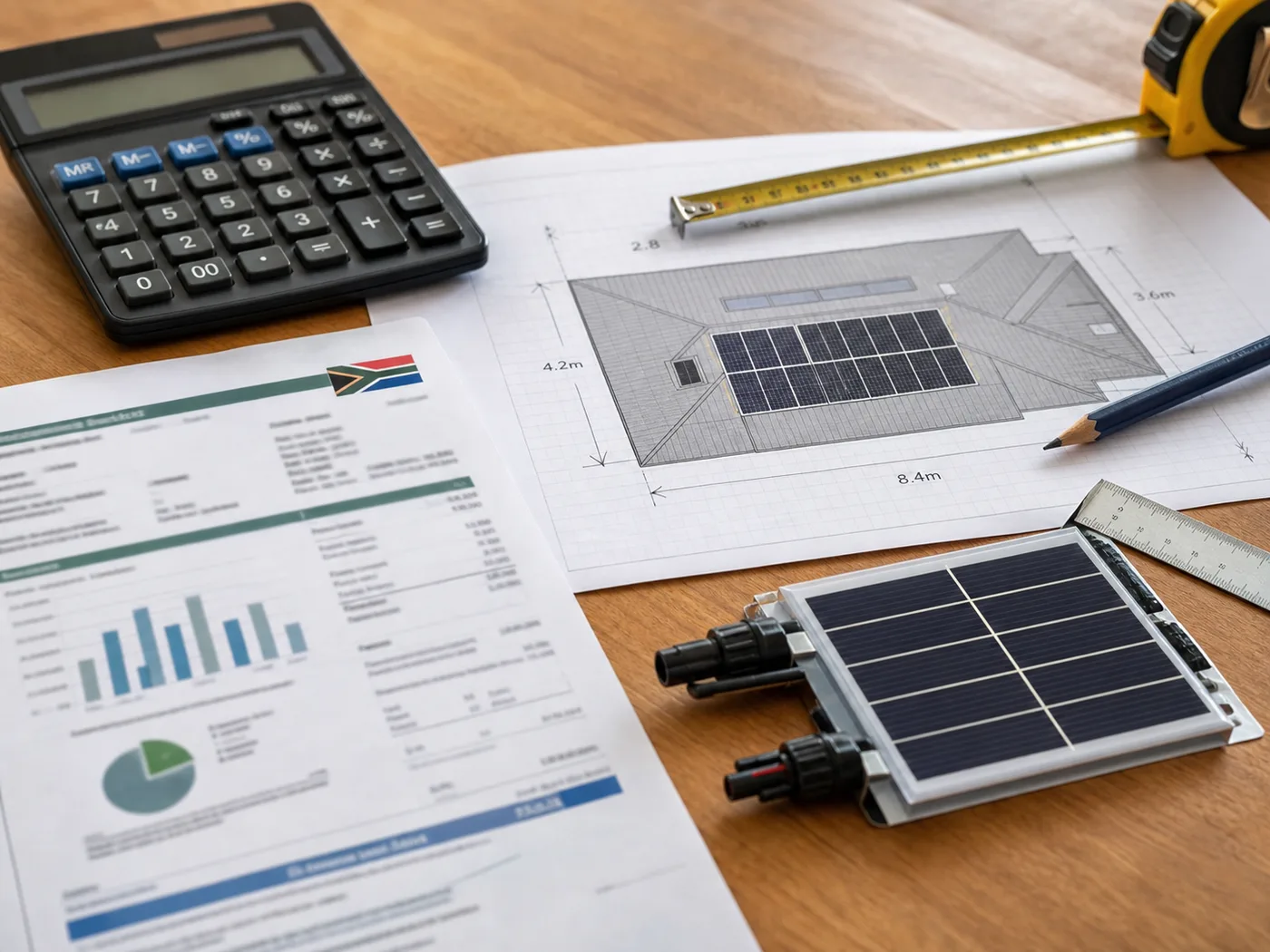
South African households and businesses can receive credit for surplus solar electricity in some Eskom and municipal supply areas. The arrangement is usually net billing, not one-for-one net metering: the distributor measures imports and exports separately, charges its normal import tariff, and credits exported units at a different rate.
The rate, fixed charges, meter cost and payout rules depend on the electricity supplier shown on your bill. That means there is no single national solar feed-in tariff. This guide explains the terms, shows how the calculation works, and uses current Eskom and Cape Town rules as examples without pretending that they apply in every municipality.
Key takeaways
Most South African export arrangements are net billing: imported and exported units have different prices.
You need an authorised SSEG connection and approved bidirectional meter before exports can be credited.
A unit used in your home usually saves more than the same unit earns when exported.
Eskom direct customers with grid-tied generation use the Homeflex time-of-use tariff and can receive a Gen-offset credit under its rules.
Cape Town's published 2026/27 residential feed-in tariff is 107.98 c/kWh excluding VAT, with a separate 25 c/kWh SSEG incentive, subject to the City's tariff conditions and fees.
Net metering, net billing and feed-in tariffs
These terms are often mixed together, but they describe different ways of valuing electricity.
Net metering
Under true one-for-one net metering, each kilowatt-hour exported offsets a kilowatt-hour imported at the same value. If you import 500 kWh and export 150 kWh, billing may be based on a net 350 kWh, subject to the scheme's rules.
That simple model is uncommon in South Africa.
Net billing
Net billing records the two flows separately. You pay the retail tariff for electricity imported from the grid and receive an export credit based on the distributor's approved generation or feed-in rate. Fixed, network, capacity and administration charges can still apply.
This distinction explains why adding exported units and imported units together does not give an accurate saving. You need the rate for each flow and every monthly charge.
Feed-in tariff
A feed-in tariff is the rate paid or credited for each kilowatt-hour exported. Some schemes place the credit on the municipal or Eskom account. Others have a process for paying an eligible credit balance. The feed-in rate is not necessarily the same as the tariff used to buy electricity.
How solar export credit is calculated
A useful monthly estimate has four parts:
Bill component
Calculation
Imported electricity
Imported kWh multiplied by the applicable import rate or time-of-use rates
Export credit
Exported kWh multiplied by the approved feed-in or Gen-offset rate
Fixed charges
Service, network, capacity, meter or administration charges
Net account effect
Import charges plus fixed charges, less allowed export credit
Suppose a home imports 400 kWh and exports 100 kWh. If the import and export rates differ, the account is not billed as a simple net 300 kWh. The distributor prices the 400 imported units, prices the 100 exported units separately, and then applies the credit according to its rules.
On a time-of-use tariff, the period can also matter. An exported unit at midday may not carry the same value as an imported unit during an evening peak. Read our guide to electricity tariffs in South Africa before modelling export income.
Eskom solar feed-in under Homeflex
Eskom requires directly supplied residential customers with grid-tied generation to use the Homeflex tariff. Homeflex is a time-of-use tariff with fixed and usage-based components. Its net-billing mechanism is called Gen-offset.
Eskom's tariff documentation says the monthly credit is based on energy exported in each time-of-use period, with limits and tariff components defined by the schedule. The current tariff structure and annual pricing documents are available on Eskom's tariffs and charges page.
Do not evaluate Homeflex from the export rate alone. The calculation should include:
peak, standard and off-peak import prices;
the matching Gen-offset treatment;
service, administration, capacity and network charges;
the household's actual import and export profile; and
any tariff or meter conversion required for the SSEG connection.
Eskom increased Homeflex and Gen-offset Homeflex tariffs by 8.76% for 2026/27, effective for direct customers from 1 April 2026. The structure also moved more cost recovery into fixed components. Check the current tariff book rather than relying on an old blog rate.
Cape Town feed-in tariff and Cash for Power
Cape Town has one of the country's most established residential SSEG and feed-in processes. For the 2026/27 financial year, the City's published tariff schedule lists:
a residential SSEG feed-in tariff of 107.98 c/kWh excluding VAT; and
a separate SSEG feed-in incentive of 25 c/kWh excluding VAT.
The City's 2026/27 tariff schedule also says the residential feed-in tariff is available only to approved residential SSEG connections on the Home User tariff and that an AMI administration fee applies.
To feed in, the property needs an authorised SSEG system and an Advanced Metering Infrastructure meter. The City's SSEG application page says the customer pays for the AMI meter for a feed-in installation. A non-feed-in installation with reverse-power-flow blocking follows a different metering and tariff route.
Cash for Power refers to the City's mechanism for qualifying sellers to receive payment rather than leaving all credit on the municipal account. Registration, vendor setup, account status and programme terms matter. Do not size a system around a projected cash payout until the City confirms that the property and account qualify.
Not sure which system you need?
Get a free, no-obligation quote sized to your home, usage and budget. It only takes a minute.
What about Johannesburg, Tshwane, eThekwini and other municipalities?
Each licensed distributor sets and publishes its own approved tariffs and connection process. Some offer residential export tariffs; some focus on commercial or larger embedded generation; others have registration without a practical household feed-in product.
Municipal rules can change each financial year, usually around 1 July. Check three primary documents for the current answer:
the municipality's approved electricity tariff schedule;
its SSEG or embedded-generation application rules; and
its metering, account-credit and payout conditions.
Tshwane, for example, asks residents interested in reverse feed to register, and states that consumption and reverse-feed tariffs are reviewed annually. That does not mean Cape Town's rate or payment rules apply in Tshwane. The Embedded Generation Resource Portal is a useful starting point for municipal documents, but the distributor remains the final source.
SolarGuide's local guides cover the broader installation context in Cape Town, Johannesburg and Durban. Confirm the current export tariff directly before including revenue in a payback calculation.
What you need before exporting solar
SSEG authorisation
The system must be registered with the electricity distributor. NERSA's current position is that grid-connected systems of 100 kVA or less register with Eskom or the municipality, whether or not they export. The SSEG registration guide explains the documents and 2026 Eskom fee waiver.
An approved inverter and export settings
The distributor needs evidence that the inverter and protection comply with its technical requirements. Export limits and anti-islanding settings must match the approved design. Changing settings after approval can place the connection outside its authorisation.
A bidirectional meter
A standard meter is not an export settlement system. The distributor specifies, installs or approves the meter used for billing. Do not deliberately export through an old prepaid or credit meter in the hope that it will run backwards.
The correct tariff and agreement
Registration makes the connection lawful; it does not automatically create an export credit. You also need the applicable tariff, meter and signed connection or supplementary agreement.
Is selling solar back to the grid worth it?
Export is valuable when it monetises a surplus that would otherwise be curtailed. It is usually less valuable than consuming the solar on site because self-consumption avoids the full marginal import price, while an exported unit earns the lower approved credit.
Improve self-consumption before oversizing for export:
run pool pumps, geysers and flexible appliances during solar hours;
schedule business loads for the daytime where practical;
size the battery around evening consumption and backup needs;
compare the extra panel cost with realistic annual export value; and
include fixed charges, meter costs and tariff changes in the model.
For a household, export should normally improve an already sensible system rather than justify an unsuitable one. Use the solar sizing calculator as a starting point, then have the installer model the interval data and tariff. Get a free Alumo quote →
Free planning tool
Solar finance and payback calculator
Compare cash payback with a financed system, using your own bill, tariff and assumptions.
R 2 500
R 110 000
70%
Payment route
Cash payback
5.2 years
20-year net saving
R 851 001
Year-one saving
R 1 750/mo
Estimated array
4.4 kW
About 8 × 550 W panels
Roughly 23.3 m² of usable roof
Indicative scenario only. It excludes finance fees, tax effects, maintenance, export credits and site-specific generation. The assumptions are visible below so the result can be challenged instead of treated as a quote.
Rates and programmes in this guide were checked on 19 September 2026 against Eskom's current tariff pages, the City of Cape Town's 2026/27 tariff schedule and SSEG process, and current municipal SSEG guidance. Tariffs can change annually and programme terms can change sooner. Confirm the live rate before making an investment decision.
Frequently asked questions
Can I sell solar electricity back to Eskom?
Qualifying Eskom direct customers with an authorised grid-tied system can receive Gen-offset credits under the Homeflex net-billing rules. Registration, the correct tariff, an approved meter and the relevant agreements are required.
Does South Africa have one national feed-in tariff?
No. Eskom and licensed municipalities use their own approved tariffs and conditions. The rate and process depend on the electricity supplier for the property.
What is Cape Town's residential solar feed-in rate for 2026/27?
The City's published schedule lists 107.98 c/kWh excluding VAT for residential SSEG feed-in, plus a 25 c/kWh SSEG incentive. The Home User tariff, AMI fee, meter cost and programme conditions also need to be included.
Is net metering the same as net billing?
No. True net metering normally offsets exported and imported units at the same value. Net billing measures and prices imports and exports separately. Most South African household export arrangements are closer to net billing.
Should I install extra panels purely to sell electricity?
Only after modelling the extra generation, current export tariff, curtailment, meter and fixed charges, and the likelihood of future tariff changes. Self-consuming solar usually produces a higher saving per unit than exporting it.
Does SolarGuide arrange the export agreement?
SolarGuide is an independent referral partner. Alumo supplies, installs, finances and warrants its systems and can scope the technical work in its proposal. The electricity distributor controls SSEG approval, meters, tariffs and export agreements.
SolarGuide is an independent referral partner. We help you compare options and arrange a free quote — Alumo supplies, installs, finances and warrants the systems. Pricing is indicative, sourced from Alumo’s published catalogue, and subject to a site assessment and credit approval.